How We Built the Mines Automotive Track from Zero
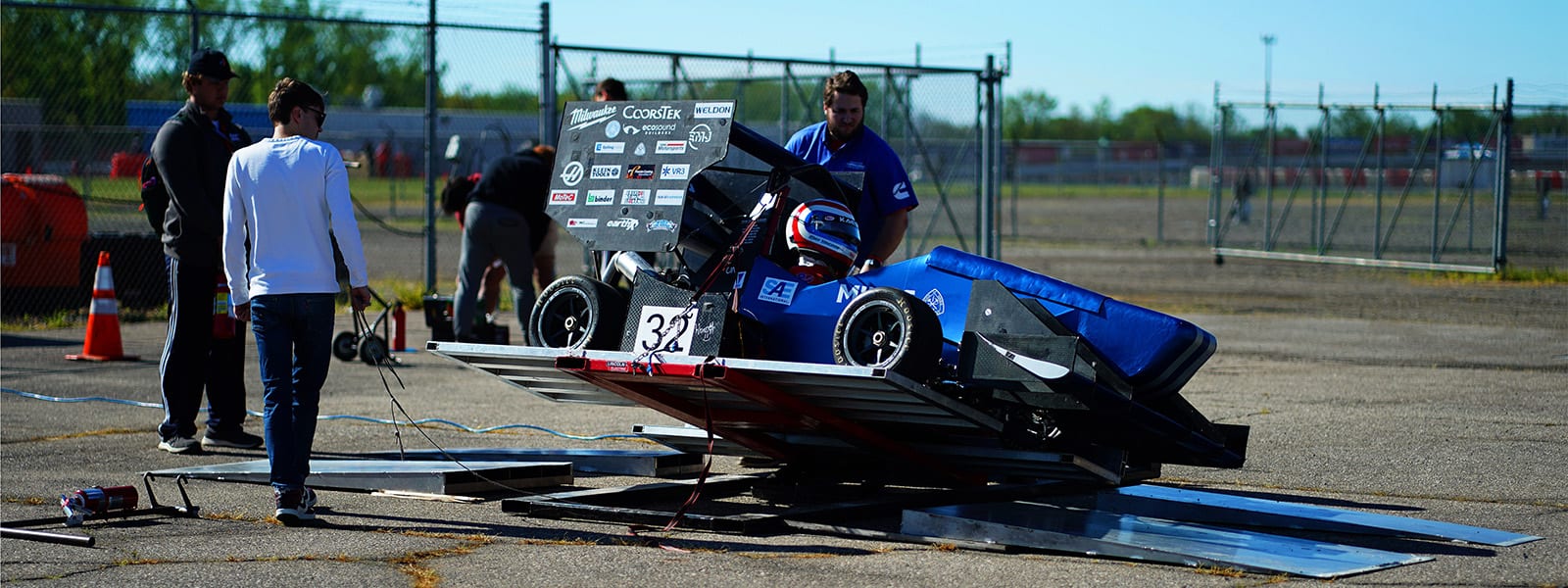
When Prof. Polina Brodsky and I started talking about an automotive engineering track at the Colorado School of Mines in 2022, the program existed only as a hypothesis. There was no department for it, no faculty lines, no curriculum committee charge, and no pot of money. Three years later, the track had grown to a major declared-undergraduate cohort, eight new courses, and two top-five national competition finishes. It is the second-largest elective track in Mechanical Engineering, behind only Aerospace, and we are still operating with two core faculty.
I get asked often how we did it, and especially what other faculty trying to build something similar should and should not do. Here is the honest version, including the mistakes.
What we got right
1. We built a course portfolio before we asked for a program
The temptation when you want to start a new program is to write a proposal, gather signatures, and try to formalize before you have anything to show. We did the opposite. We put the two required track courses (MEGN 391 Introduction to Automotive Design, MEGN 417/527 Vehicle Dynamics) on a stable footing first, rebuilding both around integration projects. We then curated the track’s elective slate from existing ME and EE offerings so that students could specialize toward a focus area: vibrations, controls, electric vehicle powertrains, fuel cells, combustion, aerodynamics, or CFD. By the time anyone needed to evaluate the program institutionally, the course portfolio already existed. Curriculum committees reviewed individual courses, not a contested new track.
This sequencing matters because new programs trigger institutional immune responses. A coherent set of already-running courses with enrollment data does not.
2. We made the competition teams the front door
The Mines Battery Workforce Challenge team, Formula SAE, and Shell Eco-marathon serve as recruiting funnels and curricular anchors in our model. A first-year student who joins FSAE in October has, by January, met every track instructor and seen the kind of work upper-division automotive students do. We did not have to convince anyone to declare the track. The teams did the convincing.
The lesson generalizes: if your program has a high-visibility student artifact, that artifact will recruit better than any brochure.
3. We treated industry partnerships as curriculum, not fundraising
When we secured the DOE Battery Workforce Challenge with Stellantis (1st place nationally Year 1), the BWC vehicle was not a side project. It became the integration platform that MEGN 391, MEGN 417/527, and MEGN 465/565 students worked on. Industry money is most useful when it directly funds student work that would have happened anyway, not when it funds parallel research that competes for student attention.
4. We refused to wait for permission to do hard things
Two examples. We rebuilt MEGN 391 (Introduction to Automotive Design) around student-built RC cars as the semester integration project, turning a lecture course into a design-build-test loop with no precedent in the department. We then rebuilt MEGN 417/527 (Vehicle Dynamics) around an integrated electric go-kart platform and a multiaxis driving simulator, so that suspension, tire, and powertrain theory is verified on a vehicle students can instrument and tune. Both were structurally weird relative to the rest of the curriculum. Both are now flagship courses.
The institution will eventually accommodate what works. It will not initiate it.
What we got wrong
1. We underestimated the operational tax
Two faculty managing a large declared cohort, eight courses (some online, some hybrid, some lab-heavy), three competition teams, capstone advising, a mentoring portfolio of 18+ independent study students, and the FE Exam Review program is, in measurable terms, unsustainable. We have not yet broken anything important, but we have come close. Anyone replicating this should plan for the third faculty member from the start, not three years in.
The Mines Automotive 5-Year Strategic Plan I drafted in Fall 2025 explicitly addresses this. The plan is not just about growth; it is about avoiding the failure mode where the people who built the program leave because they are exhausted.
2. We over-indexed on competition wins as a quality signal
The 1st place national finish in BWC Year 1 was real and we are proud of it. But it also created an internal narrative that competition standing equals program health. It does not. We had a 4th place finish in Year 2 with a stronger team and a more mature project. The standings do not always track what you want them to.
For external audiences (donors, deans, prospective students), competition wins are the right shorthand. For internal program design, they are a noisy signal.
3. We built faster than we documented
The first two years of the program produced a lot of working systems and not much written documentation. As we head into 2026 we are belatedly writing it down, including the open course materials now hosted on GitHub for MEGN 300, MEGN 301, and Capstone. If I were starting over, I would write the documentation alongside the courses, not three years later.
What other faculty should take away
If you are trying to build a similar track at your institution, the order matters more than any individual decision:
- Stabilize what you already have. Do not propose new things until your existing courses have predictable enrollment and high evaluations.
- Find your competition or signature artifact. Something a freshman can see and want to join.
- Use industry partnerships to fund work students would do anyway. This is the only sustainable model.
- Plan for the third faculty member from day one. You will need them.
- Document as you go. Future you will thank present you.
What built the Mines automotive track was a refusal to ask permission for things that were obviously right, and a refusal to skip the unglamorous operational work that makes the visible parts function. Three years in, that has translated to a large declared cohort, eight courses, a growing federal grant portfolio anchored by BWC, and a program ranked second in the department by enrollment.
Anyone building something like this is welcome to email me. The model travels.
Discuss this essay
If this resonated, contradicted your experience, or you want to talk about something related, email me directly. I read everything.
Email Me